

Forklift safety sounds simple until you actually see what happens when a load is carried too high. One wrong turn, one sudden brake, or one uneven floor can transform a stable forklift into a dangerous tipping machine within seconds. That is why understanding the correct forklift load height is not just about following regulations. It is about protecting operators, nearby workers, inventory, warehouse infrastructure, and the forklift itself.
According to guidance from the Occupational Safety and Health Administration (OSHA), forklift operators should generally carry loads about 6 to 8 inches above the ground while traveling. OSHA also emphasizes that operators should never travel with elevated loads because it significantly increases the risk of tip-overs and falling materials.
Modern warehouses are moving faster than ever. Narrow aisles, taller racking systems, and tighter deadlines all create pressure on forklift operators. But speed without stability is like trying to balance a refrigerator on a skateboard. It may move for a moment, but disaster is waiting around the corner. Understanding proper load carrying height helps companies avoid accidents, OSHA violations, damaged goods, and expensive downtime.
Why Forklift Load Height Matters
Forklift load height directly affects the machine’s balance, visibility, and stopping ability. Think of a forklift like a seesaw. The higher the load rises, the more unstable the balance becomes. Even a perfectly balanced pallet can become dangerous when carried too high because the forklift’s center of gravity shifts upward and forward. Once that invisible balance point moves outside the forklift’s stability triangle, the machine can tip over surprisingly fast.
Warehouses often look calm from the outside, but they are packed with movement. Forklifts are constantly weaving through aisles, crossing loading docks, entering trailers, and maneuvering around pedestrians. In this environment, even a small mistake becomes amplified. A raised load blocks visibility, reduces steering stability, and makes sudden braking more dangerous. OSHA specifically warns against traveling with elevated loads because these conditions dramatically increase accident risks.
The consequences go far beyond damaged pallets. Forklift tip-overs remain one of the leading causes of serious warehouse injuries. Loads can slide off forks, strike workers, collapse shelving systems, or crush operators during a rollover. Online workplace safety discussions frequently show how quickly elevated loads lead to accidents, especially during turns or uneven movement.
Businesses also suffer financially when forklift safety is ignored. Damaged inventory, OSHA penalties, downtime, workers’ compensation claims, and equipment repairs can cost thousands or even millions of dollars annually. That is why professional operations treat proper load height as a non-negotiable safety standard rather than a suggestion.
The Relationship Between Stability and Load Height
The higher a load is lifted during travel, the more unstable the forklift becomes. It is similar to carrying a ladder upright on a windy day. The taller the object, the harder it becomes to control momentum and balance. Forklifts operate under the same principle. Raising the load increases leverage against the forklift’s center of gravity.
OSHA explains that forklifts are engineered around specific load centers, commonly 24 inches from the fork face. When the load shifts forward or upward, the truck’s rated capacity effectively decreases. This means a forklift capable of safely lifting a certain weight at ground level may become unstable with the same weight raised higher during travel.
Turning is especially dangerous. A raised load increases lateral force during movement, making side tip-overs more likely. Operators sometimes underestimate how quickly momentum changes during cornering. Even moderate speeds can become hazardous when the load is elevated.
Common Warehouse Accidents Caused by Raised Loads
Many forklift accidents follow predictable patterns. Operators carry loads too high because they want better visibility, faster stacking, or quicker maneuvering. Ironically, these shortcuts often create the exact accidents they hoped to avoid.
Some of the most common incidents include:
| Accident Type | Primary Cause |
|---|---|
| Forward tip-over | Elevated heavy load |
| Side tip-over | Fast turning with raised load |
| Falling pallets | Improper mast tilt |
| Rack collisions | Poor visibility |
| Pedestrian injuries | Obstructed operator view |
Real-world discussions among forklift operators repeatedly reinforce the same lesson: keep the load low while moving.
OSHA Guidelines for Forklift Load Height
OSHA provides clear recommendations regarding safe forklift operation. During travel, the forks should generally remain 6 to 8 inches above the floor with the mast tilted slightly backward for stability. This height helps operators clear minor floor obstacles while maintaining the forklift’s balance.
The slight backward tilt is extremely important. It secures the load against the carriage and minimizes forward shifting. Without this tilt, pallets can slide forward during braking or movement. OSHA regulations specifically mention careful mast tilting to stabilize the load before travel.
Traveling with elevated loads is strongly discouraged because it increases several hazards simultaneously:
- Reduced stability
- Obstructed visibility
- Greater stopping distance
- Increased chance of load shifting
- Higher tip-over risk
Forklift manufacturers also design machines assuming operators follow these travel-height recommendations. Ignoring them places unnecessary stress on hydraulic systems, steering components, and mast assemblies.
Recommended Traveling Height
The industry standard of 6 to 8 inches is not random. It is the result of decades of safety analysis and engineering experience. At this height, operators maintain enough clearance to avoid scraping the ground while keeping the load’s center of gravity as low as possible.
You can think of it like carrying a heavy bucket. When you carry it close to the ground, it feels stable. Raise it chest-high while walking quickly, and suddenly every movement feels awkward and unstable. Forklifts behave the same way.
Some environments may require slightly different approaches. Outdoor yards with rough terrain, potholes, gravel, or uneven concrete may require operators to slightly increase fork height for clearance. Even then, the load should remain as low as safely possible.
OSHA Rules About Elevated Loads
OSHA explicitly warns operators never to travel with elevated loads. Elevated travel should only occur during stacking or placement procedures when the forklift is stationary or moving minimally.
Operators should also avoid:
- Raising or lowering forks while moving
- Turning with elevated loads
- Driving on inclines with unstable positioning
- Carrying oversized loads without proper visibility
These rules exist because forklifts are inherently different from cars or trucks. Their steering geometry, counterweight balance, and narrow wheelbase make them extremely sensitive to center-of-gravity changes.
The Science Behind Forklift Stability
Forklift stability depends on physics more than power. Many operators assume bigger forklifts automatically mean safer operation, but stability is governed by weight distribution and balance rather than engine size alone.
Understanding the Center of Gravity
Every forklift has its own center of gravity. Add a load, and the combined center of gravity shifts forward. OSHA explains that forklifts remain stable only when this combined center stays within the machine’s stability triangle.
This formula explains why heavier loads or longer load centers increase instability. If operators raise the load too high, the center of gravity moves upward and forward simultaneously, increasing rollover potential.
A forklift carrying a low pallet behaves like a grounded athlete with bent knees. Raise the load too high, and the machine becomes like a tightrope walker struggling to balance.
The Stability Triangle Explained
The stability triangle is formed between the forklift’s two front wheels and rear axle pivot point. As long as the combined center of gravity stays inside this triangle, the forklift remains stable.
Problems begin when operators:
- Turn sharply
- Brake suddenly
- Travel across slopes
- Carry elevated loads
- Exceed load capacity
These actions push the center of gravity outside the triangle, causing tip-overs.
How High Should Forks Be While Traveling
The answer for most warehouse operations is simple: keep the forks about 6 to 8 inches off the ground with the mast slightly tilted backward.
This standard applies across many industries, including manufacturing, warehousing, logistics, retail distribution, and construction supply yards.
Standard Indoor Warehouse Operations
Indoor warehouse floors are usually smooth and predictable, making low travel heights practical and safe. Operators should:
- Keep loads low
- Drive slowly around corners
- Travel in reverse if visibility is blocked
- Avoid sudden stops
Traveling with the load low improves steering and reduces the chance of pallet instability. It also minimizes rack collision risks in narrow aisles.
Outdoor and Rough Terrain Conditions
Outdoor conditions introduce additional challenges such as potholes, gravel, mud, and uneven pavement. Rough terrain forklifts and diesel forklifts are often used in these environments because of their larger tires and stronger suspension systems.
Even outdoors, the same principle applies: keep the load as low as safely possible. Operators may need slightly higher fork positioning to clear obstacles, but excessive height still increases rollover danger.
Risks of Carrying a Load Too High
Forklift accidents often happen because operators become comfortable. Familiarity creates shortcuts. Shortcuts create instability.
Increased Tip-Over Risk
Tip-overs are among the deadliest forklift accidents. A raised load acts like a lever pulling the machine forward or sideways during turns and stops.
Online forklift communities frequently discuss accidents caused by elevated travel. Many experienced operators warn that carrying loads too high dramatically increases tipping risks, especially with reach trucks or heavy pallets.
Falling Loads and Product Damage
Improper load height also increases the chance of dropped inventory. A poorly tilted mast or elevated pallet can shift during movement. Once momentum takes over, even shrink-wrapped pallets may slide or collapse.
Warehouses storing electronics, pharmaceuticals, beverages, or glass products can suffer massive losses from a single dropped load.
Visibility Problems for Operators
High loads often block the operator’s forward view. OSHA recommends traveling in reverse when the load obstructs visibility.
Poor visibility creates pedestrian hazards, rack impacts, and trailer-entry accidents. In busy warehouses, blocked vision can turn forklifts into moving blind spots.
Proper Forklift Mast Position During Travel
Forklift mast angle matters just as much as load height. Operators should slightly tilt the mast backward during travel to stabilize the load. OSHA specifically references backward mast tilt as a key safety practice.
Why Slight Backward Tilt Matters
Backward tilt helps secure the load against the carriage. It reduces forward shifting during braking and prevents pallets from sliding off forks.
Too much tilt, however, creates its own issues. Excessive backward angle may destabilize tall loads or damage products. The goal is controlled, moderate stabilization rather than aggressive leaning.
Professional operators develop a feel for correct mast positioning through experience and training. Good operators make forklifts look smooth and effortless because they understand balance intuitively.
Safe Forklift Practices on Ramps and Inclines
Ramps introduce gravity into the equation, making forklift operation even more sensitive.
OSHA recommends keeping the load upgrade regardless of travel direction.
Traveling Uphill With a Load
When driving uphill:
- Move forward
- Keep forks pointed uphill
- Maintain slow speed
- Avoid turning on inclines
This keeps the load stable against gravity.
Traveling Downhill Safely
When descending:
- Drive in reverse
- Keep the load uphill
- Face downgrade while reversing
- Avoid sudden braking
These practices prevent forward tip-overs and load loss.
How Forklift Type Affects Load Carrying Height
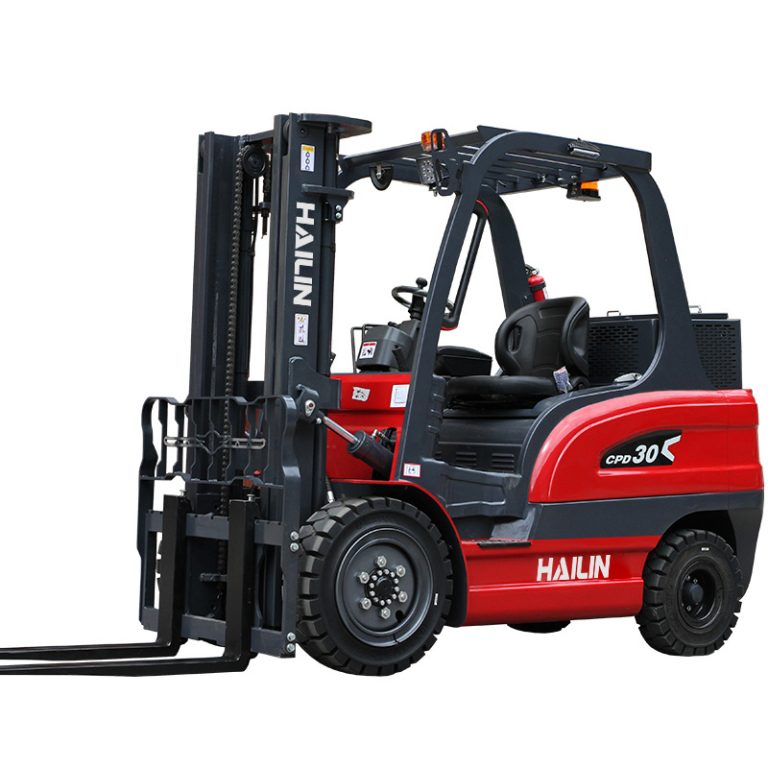
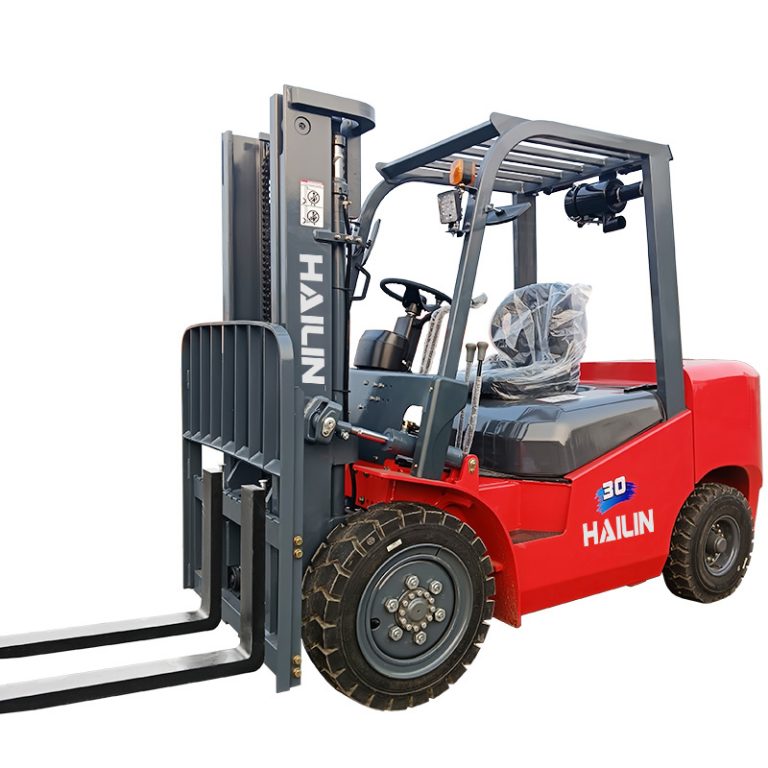
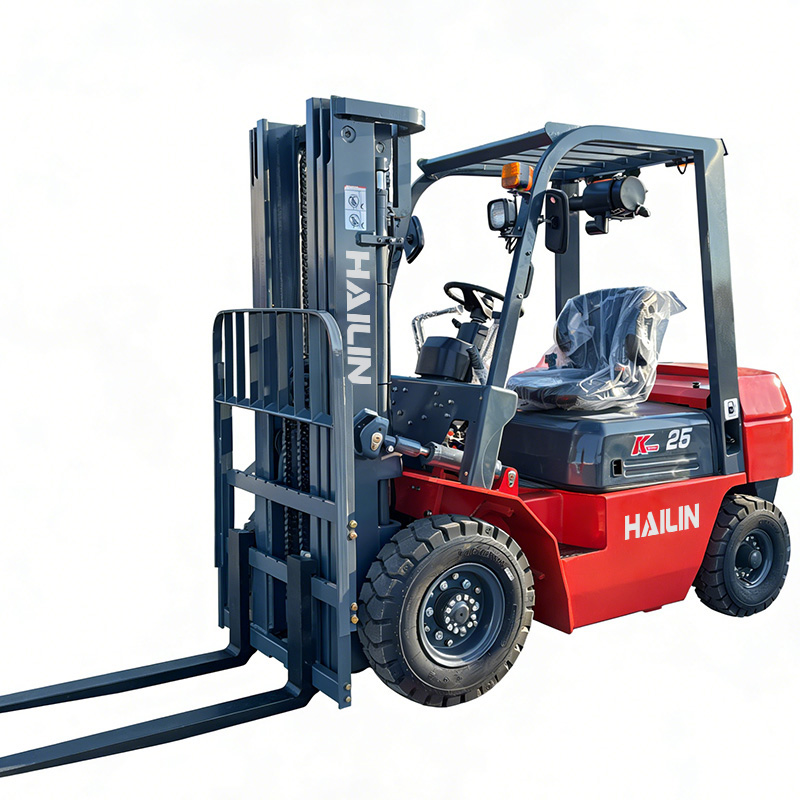
Different forklifts handle loads differently based on design, tires, and operating environment.Many industrial operators also use forklifts from brands like Hailin Forklift because they offer a wide range of diesel, electric, LPG, and rough terrain forklift models for warehouse and outdoor applications. Hailin manufactures forklifts ranging from 2-ton diesel forklifts to large-capacity industrial units and rough terrain forklifts designed for uneven job sites.
For example, Hailin diesel forklift models such as the FD25, FD30, and CPCD30 are commonly configured with duplex or triplex masts and lifting heights up to 6 meters. These machines are built for logistics yards, factories, construction material handling, and warehouse loading operations where stable load carrying is critical. Even with high lifting capability, operators should still travel with loads carried low to the ground — usually around 6 to 8 inches — to maintain proper forklift stability and visibility.
Electric Forklifts
Electric forklifts dominate indoor warehouses because they are quiet, compact, and emissions-free. They work best on smooth surfaces where low load travel height is easy to maintain.
Their smaller design means balance becomes especially important during elevated travel.
Diesel Forklifts and Rough Terrain Forklifts
Diesel forklifts and rough terrain forklifts are commonly used outdoors in lumber yards, ports, construction sites, and heavy industrial facilities. Brands like HAILIN Forklift manufacture diesel and terrain forklifts designed for challenging environments where uneven ground requires stronger stability and lifting performanc
These forklifts can handle rough surfaces better, but operators must still avoid excessive load height during travel. Bigger tires do not eliminate physics.
Common Mistakes Forklift Operators Make
Even experienced operators sometimes develop unsafe habits.
Driving With Elevated Forks
This is one of the most dangerous and most common forklift mistakes. Operators often raise loads early to save time before stacking. Unfortunately, elevated travel drastically increases instability.
Safety discussions online consistently warn against this behavior because it has caused numerous injuries and tip-overs.
Turning Too Fast With a Raised Load
Turning generates lateral force. Combine that with an elevated center of gravity, and the forklift can tip sideways rapidly.
Sharp turns should always be taken slowly, especially when carrying heavy or awkward loads.
Forklift Training and Safety Culture
Forklift safety ultimately depends on training and workplace culture. Companies that prioritize speed over safety create environments where accidents become inevitable.
Why Operator Training Matters
Proper training teaches operators:
- Correct travel height
- Safe turning procedures
- Ramp operation
- Load balancing
- Visibility management
- Emergency response
Experienced operators understand that forklifts are precision machines, not racing vehicles. The best forklift drivers move smoothly, predictably, and patiently.
Warehouses with strong safety cultures also encourage reporting unsafe behavior without fear of punishment. That openness prevents accidents before they happen.
So, how high should a load be carried on a forklift? In most situations, the safest answer is 6 to 8 inches above the ground with the mast slightly tilted backward. This position provides the best balance between stability, visibility, and obstacle clearance. OSHA guidance consistently supports low travel height because elevated loads dramatically increase the risks of tip-overs, falling pallets, and collisions.
Forklift safety is really about respecting physics. Every inch higher changes the machine’s balance. Every sharp turn amplifies momentum. Every shortcut increases risk. Operators who understand these principles become safer, smoother, and more efficient over time.
Warehouses may become faster and more automated in the future, but the fundamentals of forklift stability will never change. Keep the load low. Keep movements controlled. Respect the center of gravity. Those simple habits save lives every single day.
FAQs
1. What is the safest height to carry a forklift load?
The safest forklift travel height is usually 6 to 8 inches above the floor with the mast tilted slightly backward.
2. Why should forklift loads be kept low?
Keeping loads low improves stability, visibility, and steering control while reducing tip-over risk.
3. Can you drive a forklift with the load raised?
OSHA advises against traveling with elevated loads because it significantly increases accident risks.
4. Should forklifts travel forward or backward with large loads?
If the load blocks visibility, operators should travel in reverse while maintaining a clear view of the direction of travel.
5. Does forklift type affect load carrying height?
Yes. Electric forklifts, diesel forklifts, and rough terrain forklifts may operate in different environments, but all should keep loads as low as safely possible during travel.